

7 Tiny Ways to Help You Get Out of Bed when Crushing Depression Fatigue Strikes
I’ve had mornings when the struggle to get up is unrelenting, even when the urge to go to the bathroom arises.
In this post, I’ll share how morning fatigue is a common symptom of depression. We’ll also take a look at the five most important things to remember when depression makes you feel miserable.
Morning Depression Fatigue
Feeling tired and more depressed in the morning can be a symptom of many different forms of depression. According to the Diagnostic and Statistical Manual (DSM-5) chronic depression is a diurnal mood variation, sometimes referred to as morning depression.
Struggling to get up in the morning can be a symptom of other forms of depression too, so it’s really important to seek support from a mental health professional.
I ended up getting a treatment plan that addressed my morning fatigue as part of ongoing therapy at The Priory
Based on my treatment experience I was able to determine 7 tiny (but effective) ways to help you get out of bed when crushing depression fatigue strikes. But before I share my tips, I’d like to remind you I’m not a mental or medical health professional and this information is not a substitute for medical care.
And now, as promised, here are my seven best tips for helping you combat morning depression fatigue.
Tip#1 Be Kind to Your Mind
Listen in on your thought and notice the way depression tends to layer your experience with automatic negative thoughts (ANT’s). For example, you might notice your thoughts turning to beating up on yourself. In these moments, remind yourself you are experiencing the symptoms of depression. Give yourself some grace; depression isn’t a motivational issue.
Don’t let depression guilt take hold. You wouldn’t put pressure on yourself to mend a broken leg with your thoughts, so resolve to stop following the guilt-stream of thought.
[eltdf_highlight background_color=”#e2c1ca” color=””]Decide to conserve your energy by meeting your experience with compassion.[/eltdf_highlight]
Tip#2 Come Home to Your Breath
When depression has you struggling to get out of bed, think of each breath as a resilient friend, cheering you on.
Take a deep inhalation and feel your belly expanding.
Let out a long, slow exhalation to the count of five.
Repeat several times.
Studies show that breathing in this way rejuvenates the nervous system, reducing the symptoms of anxiety and depression.
Tip#3 Do This One Stretch In Bed
Curl up and roll over, pushing yourself up onto all fours. Kneel back over your heels and lean forward, bringing your chest as close to your knees as possible.
Lower down so your forehead comes to rest on your pillow. Stack your hands underneath your forehead and breath (5–10 breaths or more).
This yoga stretch called Balasana, or Child’s Pose, helps relax and calm your body and mind.
Tip#4 Take One Action Step
I know how debilitating it can be when it’s time to get up and your body is screaming, it can feel like a real struggle. According to The Priory, rather than thinking of the day ahead in its entirety, take it one step at a time. Keep it really simple. Make it something that nourishes and supports you.
My one thing in the morning is having a glass of water, which I use to take my medication. Believe me this is a big step for me, because it actually requires getting up.
Once you have finished your one thing, take a moment to let yourself feel a sense of accomplishment and use this to spark your next action. When you feel like you are making some progress, no matter how small your gains, it increases positive emotions. Furthermore in one study investigating the effects of making small daily goals, it was found that doing so can actually begin to reduce the symptoms of depression.
Tip#5 Treat Yourself
Treat yourself with one thing that makes you feel a little better. It could be a simple as washing your face, or cleaning your teeth. Tiny steps give you a sense you can live bravely. Once you are up out of bed, do something that nourishes the senses and brings you joy.
Play your favourite music, brew some tea or coffee, have a shower or go for a walk.
Gretchen Rubin, author of Better Than Before, says while “treating yourself. sounds like a self-indulgent, frivolous strategy, it’s not. She goes on to say how treats helps reinforce the effort involved in forming good habits
Tip#6 Track Your Activities
When depression is layering your thoughts with negative assumptions, it can be really helpful to have a record of what you have actually managed to do. Studies show tracking your activities helps reinforce your efforts. But remember to keep it really simple.
A Google or Pinterest search for the term “bullet journal” or “BUJO” reveals a growing trend around tracking your moods, energy levels and activities. Experiment with simply jotting things down in a notebook. Have fun with it and don’t try to emulate what anyone else is doing.
Tip#7 Be Patient With Yourself
A mind addled by depression affects self-worth, triggering a crushing cycle of rumination.
Depression has a bio-medical component and is not a personal weakness. That’s why it’s important to be patient and forgiving with yourself. You are doing the best you can under very trying circumstances.
According to Dennis Tirch (Ph.D.) cultivating compassion “allows us to engage our brain and body’s basic soothing system”
Before You Go
When you wake up with paralyzing depression fatigue, always remember — Depression fatigue is real.
I wish you well in trying these tips, because I understand how exhausting it feels to be fighting with your mind and depression is telling you “there’s no use even trying to get up”.
I believe in you.
You are stronger than you think you are and [eltdf_highlight background_color=”#e2c1ca” color=””]you’ve got this![/eltdf_highlight]
Hey Brave Love…I have a Gift For You!
I hope you found this blog post useful. I made you a little something, a free phone wallpaper that you can also use as a printable if you wish. Simple scroll down and right click to download (no-opt in required).
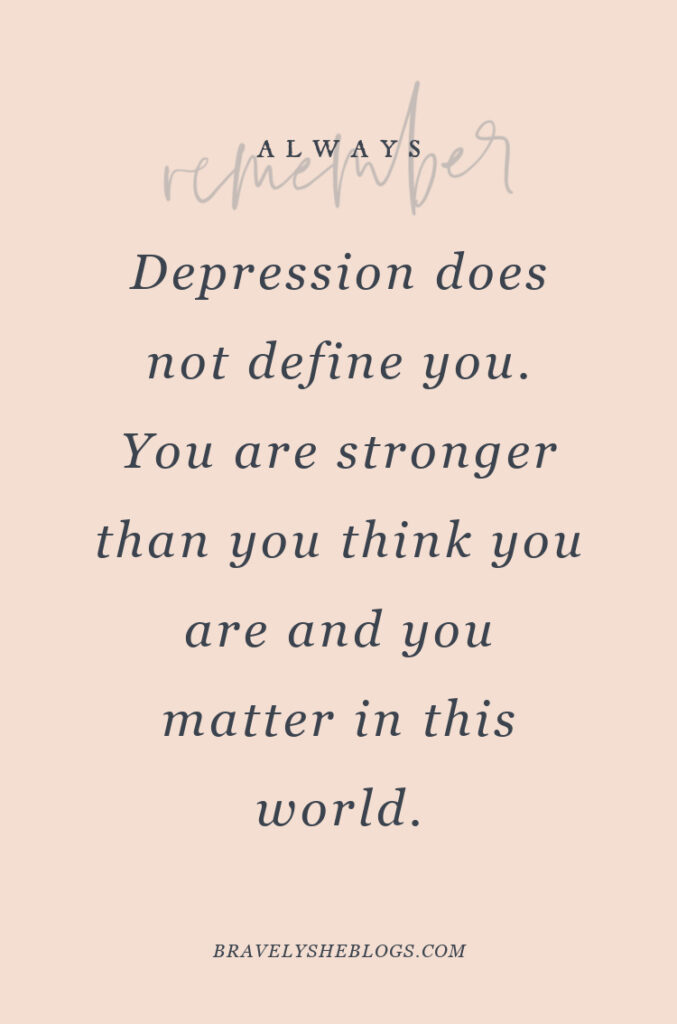 Right Click to download you free phone wallpaper
Can you relate to the experience of battling to get out of be when depression hits? I’d love to know your thoughts.
[eltdf_highlight background_color=”#e2c1ca” color=””]Have I missed anything, or is there anything you’d like to share that helped you get out of bed?[/eltdf_highlight]
I truly believe the power of our shared experience is unlocked when we share our stories.
Please PIN this post and share the love!

Oh you made it this far! Thanks for visiting my blog! Don’t forget to follow Bravely on Instagram and Pinterest, or join my newsletter community
For so long I lived by the motto “you choose how you feel in the morning.” It took awhile for me to realize, I needed more help than that. I couldn’t fake my happiness anymore. Counseling and medication was added to my motto. Even with that, people still need to work at it. You just aren’t “cured.”
Thank you for your tips and tricks. Sometimes it is the smallest thing that can help us get out of bed in the morning.
Oh hey Summer, thanks for stopping by!
For the longest time I too, got tripped up by the whole taking personal responsibility for how you feel thing. The truth is, nobody or nothing can prepare you for the indescribable ache no mamma should ever have to face. The bravest thing we can do is try to accept the whole spectrum of feeling and emotion, as it moves through us. Anything other, is a form of avoidance, or emotional by-passing.
Thank you for sharing your realization, it’s a biggie! You’re right, you can’t magic away, or “cure” the pain of waking up distraught. Stay strong, practice being patient with yourself, keep taking comfort in the little things. Beaming hugs x
My husband has always told me that making a small goal is an accomplishment. I have to make coffee first thing as my first goal. This is so helpful.
Crystal, hugs, I’m so happy you stopped by!
I’m so glad for you, it’s a very sacred and special thing when those closest to us “get it”. And you’re husband’s words ring true, it’s often the smallest actions that make the biggest difference. I can definitely relate to coffee being your first goal, ah the aroma of freshly brewed coffee in the morning, definitely helps 🙂 Stay strong Crystal, keep taking tiny brave steps, you are amazing x
This is such an important article. People just do not understand depression and judge those that are depressed for things like sleeping too much. Thank you for posting as the more awareness we can generate to the symptoms of depression and the more help we can offer, the better this disease will get (Hopefully)
Hugs Jen, and thank you. I totally agree with you about the lack of understanding and empathy around the debilitating symptoms of depression. It’s sad that from an early age, we are taught to adopt ideas around judging others. I believe our stories matter very much and as we open up and share our experiences around this terrible illness, it opens up a little more space for understanding. Keep up the great work!
I can relate to this so much!! For years getting out of bed when depression hit was such an incredibly hard task, there were days when my husband had to make me tea or breakfast and bring it to me because I didn’t have the energy to do it myself. These tips are good ones especially being kind to yourself!
Hi Sylvia, hugs and thank you. I’m so glad your husband stepped in to comfort and support you during those tough mornings. His kindness demonstrates the power of small gestures and acts of kindness, which make a tremendous difference when you are trying to manage depression overwhelm.
Thank you for sharing your experiences around depression fatigue, it helps us all feel less alone in the struggle x
These are fantastic tips. I was recently diagnosed as an adult with ADHD and have struggled with depression for what feels like my whole life. I will 100% implement try some of these the next time I am having trouble getting out of bed. 🙂
Hi Emilee, thank you for your kind words. I’m so glad you enjoyed my post. I understand ADHD can make trying new things challenging because it can make you feel like you have to do that thing a certain way. I don’t know that much about ADHD and wonder what the implications are when you are also experiencing depression. Perhaps there are others here who can relate, who can shine a light on how they manage. Emilee, I’d love to know how you go with these tips, or if you have any insights you’d like to add. Beaming hugs x
“You can’t mend a broken leg with your thoughts.” I wish more people understood this. Mental illness isn’t actually separate from physical illness, and it’s so real. Thank you for writing, and for the tips!
Hey Jules, I’m so glad you stopped by. Let’s hold on to that wish, for more widespread understanding and compassion around mental illness. Some people with depression are able to lead functional lives, but it takes a LOT of work and vast amounts of energy. Those who push the mind over matter type of ignorance around the reality of depression, need to know mental illness real, deadly real. Thank you for your kind words, and let me know how you go with the tips x
I am so glad I stumbled upon this post. I do not have clinical depression, however, I do have chronic pain that causes a depression likd state about 1-2 weeks out of every month. So I feel this to my core and I am excited to try these tricks. Thank you!
Hugs Devon, I’m really glad you found this post, welcome. Sadly, depression is one of the most common complications of chronic pain and illness. I’d really like to encourage you and those who can relate to your experience, not to not think in terms of diagnosed, not yet clinically diagnosed with depression – or depression as a symptom of something else.
Depression just IS. Depression can show up in different ways, and there’s still so much we don’t understand about this illness. But what we do know is: it’s vital to connect with supportive medical and mental health professionals, who can help us manage and treat the symptoms.
I’m really excited that you feel a resonance with my tips and experiences. Thank you so much for sharing your enthusiasm I can’t wait to hear how you go, and if there’s anything you’d like to add x